
Bajaj Auto, the king of the market for CNG-powered passenger three-wheelers, now wants to replicate this dominance in two-wheelers. The difference is that while the former is zooming - registrations for CNG-powered passenger three-wheelers nearly doubled during January-December 2023 - the latter, meaning a market for CNG-powered two-wheelers, does not exist.

With just a month left in this financial year, electric two-wheeler sales, so far, are at just 62 per cent of the ambitious target of 1 million units set for 2022-23 by the NITI Aayog. According to VAHAN data, compiled by the Society of Manufacturers of Electric Vehicles (SMEV), 620,006 units of electric two-wheelers were sold across the country in FY23 until February 21. Though the industry may miss the 1-million target, sales in FY23 are already up 146 per cent from 249,621 units sold in FY22.

Tata Power on Saturday said it has inked a pact with IIT Delhi to work together on clean energy and other projects that can be transformed from research and development level to pilot stage. Tata Power, one of India's largest private sector integrated utilities, and the Indian Institute of Technology (IIT) Delhi have signed a Memorandum of Understanding (MoU) to collaborate in areas like smart grid technology, clean energy solutions, a company statement said. Considering the large number of experts with their excellence in different fields in IIT Delhi and Tata Power, there is an immense potential to collaborate between academia, research and domain experts from business with a high transformational impact, it added.

The three companies - Ola, Hyundai and Kia - will co-create solutions to operate and manage fleet vehicles.
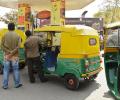
Amid a shift in mobility trends and people increasingly opting for less polluting energy sources, sales of compressed natural gas (CNG) vehicles increased more than 82 per cent in the past five years. A total of 729,902 CNG vehicles were sold in 2022-23 against 400,825 in 2017-18, according to VAHAN Dashboard. Though the increase in sales of CNG-powered vehicles has been significant, their share in overall vehicle sales remains minuscule as is the case with EVs.

India is sceptical that Tesla might import into the country cars made in China. Tesla executives were in India last month and appear to have proposed a factory in the country. But do not be surprised if that does not happen in a hurry.

India will have 30 per cent of its two-wheeler industry turning electric by 2030 as new manufacturers lead the shift, said a report on Monday. Passenger vehicles will be 15 per cent electric and the three-wheeler segment 75 per cent electric by 2030, said the report by BNP Paribas called 'India Autos-Electric vehicles: Minutes to midnight'. "We see FY22 as the year of inflection for the two-wheeler EV industry, with an accelerated EV adoption helped by incentives, wider availability, model launches, rise in crude prices and improved general awareness. We see 30 per cent of the 2W industry turning electric by 2030; the pace of incentive withdrawal presents an upside/downside risk," the report (India Autos - Electric vehicles: Minutes to midnight) said.

Prime Minister Narendra Modi made a pitch for electing a strong and stable government in an uncertain world beset by geopolitical tensions as the Bharatiya Janata Party on Sunday released its manifesto, prioritising development and welfare while shunning populist measures and contentious issues like the National Register of Citizens (NRC).

There's a hint of new competition riding into a sector that has attracted attention for being in a duopoly-like situation. Rapido, a commute app known for its budget-friendly bike-taxi services, on Tuesday announced its entry into the cab market, which is currently dominated by marquee brands Uber and Ola. Rapido's cab foray will be enabled by a software as a service (SaaS)-based platform.
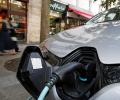
Road Transport Minister Nitin Gadkari on Tuesday said rapid strides in technology and green fuel will reduce the cost of electric automobiles, bringing them at par with petrol-run vehicles in the next two years. Replying in the Lok Sabha on the Demands for Grants for Road Transport and Highways Ministry, 2022-23, Gadkari emphasised the need to shift to cost-effective indigenous fuel and hoped that this fuel will be a reality soon, bringing the pollution levels down and improving the overall situation in Delhi.

Corporate India is starting to step up its capital expenditure plans amid government incentives and signs of rising demand, company executives and analysts have indicated. This coincides with the Reserve Bank of India (RBI) recently citing a double-digit growth in private capital expenditure. Healthy balance sheets of banks and corporates, along with increasing capacity utilisation and improving business sentiment, are contributing to a favourable environment for sustained growth in private sector investments, the RBI said in its policy last week.

With the number of start-ups reaching the unicorn level falling drastically in 2023, the Hurun Unicorn Index said it has demoted eight gazelles - start-ups that were founded in 2000 and have the potential to go to unicorn in three years - to cheetahs.

The Supreme Court, examining whether states can sub-classify the Scheduled Castes and Scheduled Tribes for the grant of a quota within a quota, said on Thursday that the state governments cannot be selective in granting reservation benefits to backward classes as it will lead to a dangerous trend of appeasement.
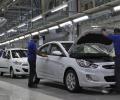
The government has decided to extend the Rs 25,938-crore production-linked incentive scheme for the automotive sector by one year, Union Heavy Industries Minister Mahendra Nath Pandey said on Tuesday. Post extension, the five-year scheme, originally in place from 2022-23 to 2026-27, will be active until 2027-28. At present, incentives are applicable under the scheme for determined sales of Advanced Automotive Technology (AAT) products (vehicles and components) manufactured in India from 1 April 2022 onwards for a period of five consecutive years.

The car was expected to have a price tag of Rs 10 lakh and launch was slated for this June.

We bring you the best places in Delhi to gorge on the tastiest kebabs, alu chaat and chole.

The electric vehicle evolution in India's passenger vehicle market has remained frozen in time and may see limited adoption over the next decade, experts say.

If 4,000 workers could work round the clock for the construction of the new Parliament building, then there is no reason why all infrastructure projects too cannot follow that model, asserts Dr Sudhir Bisht.
Hyderabad-based Gold Stone Group, which sells BYD buses in the country, is setting up a greenfield manufacturing facility at a cost of around Rs 200 crore

Besides opening up the possibility of a policy that allows vintage cars retrofitted with electric batteries to ply on roads, this also gives a clue to how cars older than 15 years that are banned can be valued again by a similar conversion to EVs, says Ritwik Sharma.

The national budget 2019-20 had an outlay of Rs 10,000 crore for Phase-II of the Faster Adoption and Manufacturing of Hybrid and Electric Vehicles scheme to boost electric mobility and increase the number of EVs in commercial fleets.

The company, which rents cars by the hour, day, week and month, has Mahindra E2O Plus and Tata E Tigor available on the platform for which it charges a subscription fee of Rs 15,000-20,000 per month.

'Some of the launches may get deferred due to the semiconductor shortage, which is unlikely to get resolved before the second half of 2022.'

Prime Minister Narendra Modi's state visit to the US is expected to see discussion on India's possible entry into a US-led global alliance on critical minerals, officials told Business Standard. In June last year, the US, the European Union, and other G7 partners launched the Minerals Security Partnership to ensure that China did not further strengthen its grip on supplies of critical minerals the world over. Various ministries, including the Ministry of Finance, have communicated to the Ministry of External Affairs to explore the possibility of India joining the partnership, officials said.

The bickering between allies All India Anna Dravida Munnetra Kazhagam and Bharatiya Janata Party in Tamil Nadu over late Dravidian stalwart C N Annadurai peaked on Monday with the regional party snapping ties with the saffron organisation, saying it cannot tolerate any affront to the late chief minister and its other leaders.

This number is more than the total number (1,071) of electric cars sold in India in calendar year 2019. MG has stopped registrations for the ZS and will cater to 2,409 of the total bookings.

According to research by IHS Markit, for an ecosystem still grappling with infrastructure issues -- the high cost of EVs and a greater OEM (original equipment manufacturer) focus on electrifying two-wheelers and commercial vehicles first -- the share of such vehicles is expected to be 4 per cent by 2030, reports Pavan Lall.

Ajit Gandhi explains how healthy habits adopted during the pandemic can help us lead a healthier and environment. friendly lifestyle.

India can become the number one automotive manufacturing hub in the world within five years, but auto companies need to enhance safety features to reduce deaths due to road accidents, Union Minister Nitin Gadkari said on Thursday. In his inaugural address at the Auto Expo 2023 here, the minister for road transport and highways asserted that the government's target is to reduce these accidents by 50 per cent before the end of 2024 while asking the auto industry to take suo moto action for road safety as the government doesn't want to make anything mandatory. Gadkari's sentiments were also echoed by Minister of Heavy Industries Mahendra Nath Pandey, who lamented that while India has only 1 per cent of the total overall vehicles, the country accounts for 11 per cent of the total global deaths due to road accidents.

He termed his grandmother and former prime minister Indira Gandhi as "the love of my life and my second mother".

Hyderabad will host India's first ever ePrix on February 11.
Signals received from the government in the past one year reflect a state of utter confusion, says Abhishek Tripathi.

There is also lack of mandate from the government on adoption of electric mobility after ambitious talks of moving all new automobile sales to electric by 2030

Politicians and Twitter warriors around the globe have a new buzzword among them: Net zero. Everyone appears to be keen to state their commitment to net zero, with India providing an outlay of Rs 35,000 crore to achieve energy transition and net-zero objectives in its Budget for FY24, even as the latest and final report by the United Nations' Intergovernmental Panel on Climate Change (IPCC) warned that current efforts are not enough to curb global warming. A number of small factory owners and businesses, however, have pointed out that the transition to net-zero emissions will cost them hugely.
The government has initiated a process to define standards and guidelines for electric charging stations.
Eyes investments of Rs 31,000 cr in research and manufacturing of electric vehicles

The company, which unveiled its compact multi-purpose vehicle Triber in India, is bringing the MPV only in petrol engine option as part of the strategy even as it prepares to introduce electric vehicles in the near future.

Auto major Mahindra has ambitious plans for its electric cars project, that include ramping up its output to 60,000 units a year, high-end electric powertrains, and 380 to 650 volt battery systems.

The promoter-brothers, distant cousins to IndiGo's Rahul Bhatia, are eyeing Air India's ground handling subsidiary to augment their aviation services business even as they make a big play in EVs.
For India to reach its bold target of having net-zero emissions by 2070, the country's solar power capacity would have to rise to over 5,600 GW, coal use particularly in the power sector will have to drop by 99 per cent by 2060 and crude oil would need to peak by 2050 and fall substantially by 90 per cent in the two decades thereafter, CEEW India has said. Prime Minister Narendra Modi on Monday surprised delegates at the COP26 climate summit with a bold pledge to cutting emissions at the world's third-biggest emitter to net-zero by 2070. Council on Energy, Environment and Water, a Delhi-based not-for-profit policy research institution, said, "The economic cost of India's net-zero 2070 transition (would be) over USD 13,000 billion between 2030 and 2100."
